Commentary: Paris Protests, Metro Station Closures and Lost Connections
Paris’s October 2026 protests and Metro station closures show why a moving train does not necessarily mean an accessible journey.
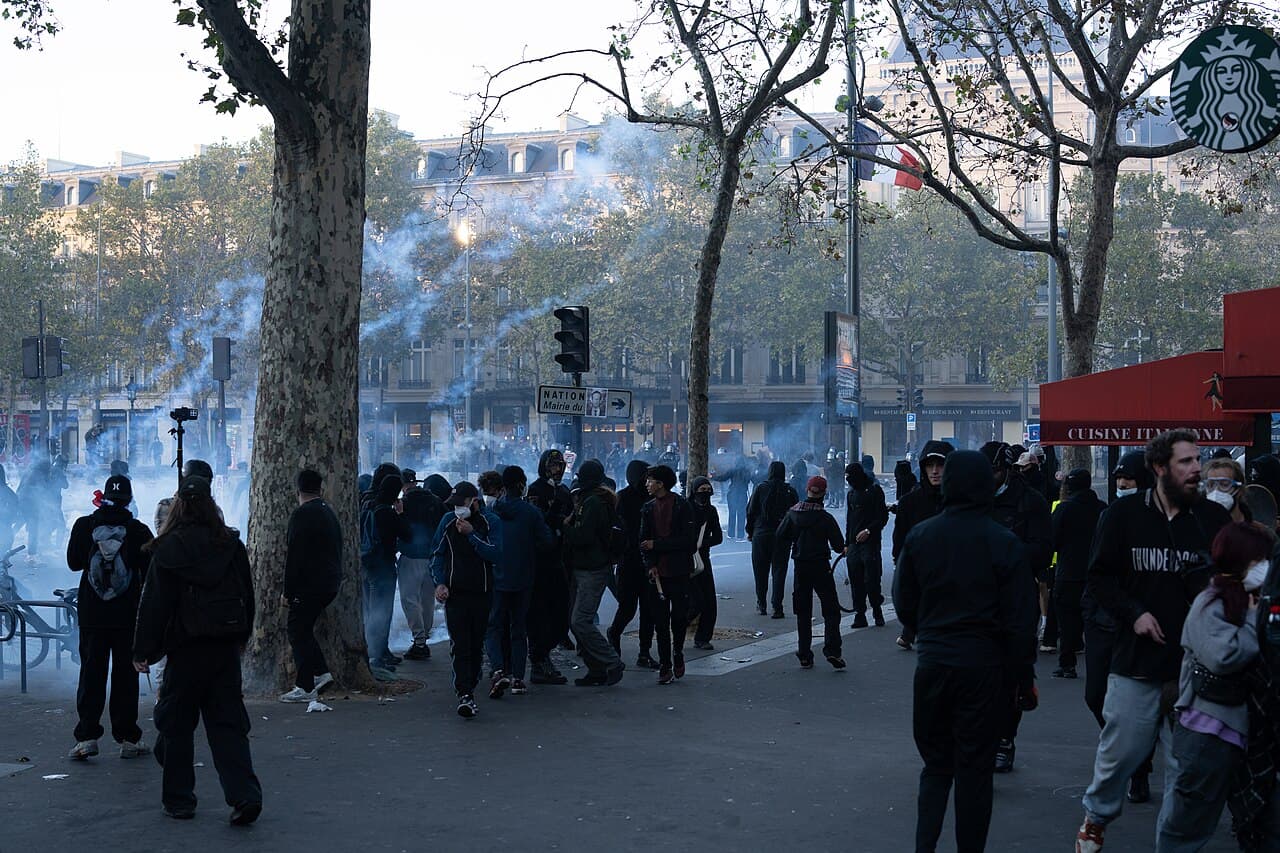
What recent protests reveal about public transport resilience.
Photo: Jorge Jaramillo / JJxFile.com, CC BY-SA 4.0. Wikimedia Commons resized the original photograph for web use.

A train can keep running and still leave passengers stranded.
On 17 October 2026, around 110,000 people joined demonstrations in Paris over rising living costs and conditions in schools. Most protested peacefully, but violent clashes and looting affected parts of the city.
For safety reasons, RATP listed 25 Metro and RER stations for closure. It also warned that some bus routes could be diverted or shortened. Further restrictions on 20–22 October affected important interchange stations.
But the interesting transport question goes beyond how many stations were closed.
When a single closure affects an entire journey
Imagine travelling across Paris. Your train is running, but it no longer stops at the station where you normally change lines. Suddenly, a straightforward journey requires a detour, additional walking, or several extra transfers.
This matters particularly at major interchanges. According to official 2025 transport statistics, Châtelet–Les Halles recorded 40.8 million annual RER entries, while République recorded 16.6 million Metro entries. The figures exclude transferring passengers, so entry counts alone cannot capture the full importance of interchange connections.
When such connections become unavailable, disruption can spread beyond the immediate area. Passengers may crowd alternative stations, while buses that might otherwise provide an alternative may also face road restrictions.
Keeping services running is not enough
This highlights a distinction between operational reliability and passenger accessibility.
The closure notices show why planning around vehicle movement alone is insufficient. A station that trains pass without stopping can remove the transfer that makes a journey practical. Operators need to examine which journeys lose their usual interchange, how much walking or waiting a detour adds, and whether nearby stations and bus routes can handle the redirected passengers.
Such an assessment could help identify the most consequential transfer points and communicate usable alternatives while respecting safety restrictions. The available notices do not quantify how many passengers were delayed, so the scale of the actual impact remains an open question.
A resilient transport system is not simply one that keeps vehicles moving. It is one that keeps people connected when normal journeys become impossible.

Enjoyed this post?
Follow me on LinkedIn for more insights on public transport optimization and research updates.
Follow on LinkedIn