Active Learning-Enhanced Constrained Bayesian Optimization for Multi-Modal and Multi-Objective Traffic Signal Control
A new simulation-based framework searches for traffic-signal plans that balance efficiency, safety, and equity across private cars, buses, and bicycles.
I am pleased to share that our paper, “Active learning-enhanced constrained Bayesian optimization for multi-modal and multi-objective traffic signal control,” has been accepted for publication in Transportation Research Part C: Emerging Technologies.
The paper is co-authored by Yunhai Gong, Christoffer Riis, Shaopeng Zhong, Tao Wang, Filipe Rodrigues, Carlos Lima Azevedo, and Yu Jiang. It has been assigned to Volume 192 (2026), Article 105872.
The full bibliographic record and access options are available through the ScienceDirect article page and the persistent DOI record.
Why this control problem is difficult
Traffic signals distribute limited junction time among competing movements. This study considers three travel modes—private cars, buses, and bicycles—and assesses signal plans against three objectives:
- Traffic efficiency
- Traffic safety
- Traffic equity
These objectives are considered together because improving one does not guarantee improvement in the others. A signal setting that favours traffic flow, for example, may not provide the preferred outcome for safety or for the distribution of benefits among modes.
The study therefore searches for a Pareto frontier, rather than one supposedly universal “best” plan. Each solution on this frontier represents a different feasible balance: improving one objective would require sacrificing at least one other objective. The framework gives decision-makers a set of high-quality alternatives without deciding the final policy preference for them.
Equity is treated as an explicit optimisation objective in the paper. This should not be interpreted as giving every mode identical signal priority at every moment; its precise mathematical definition and implementation are set out in the full article.
What the framework does
The paper proposes an active learning-enhanced, simulation-based optimisation framework. Traffic simulation evaluates candidate signal settings, while optimisation determines which settings should be examined next. This is useful because testing every possible combination would be computationally expensive.
The study develops four constrained multi-objective Bayesian optimisation (cMBO) methods. Bayesian optimisation constructs a statistical approximation—often called a surrogate model—of how signal settings affect the objectives. It then uses that approximation to select a promising or informative setting for the next simulation.
The word constrained is important. The search must identify solutions that satisfy the feasibility requirements represented in the model, rather than simply finding attractive objective values outside the feasible region.
The basic cycle is:
- select a candidate signal plan;
- evaluate it through traffic simulation;
- update the statistical model using the new result; and
- select the next evaluation while accounting for objectives and constraints.
What active learning and FBGP add
Two of the four cMBO variants combine fully Bayesian Gaussian processes (FBGP) with active learning (AL). In plain terms, a Gaussian process estimates the likely performance of signal settings that have not yet been simulated and represents uncertainty around those estimates. The fully Bayesian treatment accounts more comprehensively for uncertainty in the model’s parameters.
Active learning then helps determine where a new simulation would be most useful. The two enhanced variants reconstruct the constrained acquisition function—the rule used to select the next candidate—so that the search balances:
- exploration, learning about uncertain parts of the decision space; and
- exploitation, concentrating on areas already expected to contain strong feasible solutions.
The intended effect is not to replace traffic simulation, but to use a limited simulation budget more selectively and to reach a high-quality Pareto frontier more efficiently.
How the methods were evaluated
A Copenhagen intersection
The four cMBO methods were first tested using a typical isolated intersection in Copenhagen. They were compared with two established multi-objective optimisation methods: Non-dominated Sorting Genetic Algorithm III (NSGA-III) and COMBOO.
The experiments reported three main findings:
- Solution quality: the proposed cMBO methods produced better solutions than the comparison methods. In particular, the two variants combining FBGP and active learning identified solutions that improved efficiency, safety, and equity simultaneously relative to the state-of-the-art comparators.
- Convergence: the two FBGP-and-AL variants reached the Pareto-optimal front more quickly. Their iterative results showed marked jumps in Pareto-front performance when active learning identified especially informative evaluations.
- Stability: sensitivity analysis of the methods’ hyperparameters provided further evidence that their performance was stable under the tested settings.
Extension to a larger network
The framework was then applied to a real-world 3 × 3 urban traffic network. This second experiment showed that the approach could be extended from one isolated junction to a larger, more complex multi-intersection setting. The paper presents this as evidence of scalability and practical applicability for network-level multi-modal traffic signal control.
This remains a simulation-based evaluation. The reported practical applicability should therefore be understood as successful application to a real-world network model, not evidence of live on-street deployment.
What the findings mean
The study’s contribution is both methodological and operational. Methodologically, it extends unconstrained Bayesian optimisation to four constrained, multi-objective algorithms and introduces FBGP-and-AL enhancements for selecting simulations. Operationally, it demonstrates a way to examine trade-offs among cars, buses, and bicycles across efficiency, safety, and equity without collapsing those considerations into a single objective.
The Copenhagen intersection comparison supports the conclusion that the enhanced methods found stronger Pareto solutions and converged faster than NSGA-III and COMBOO under the tested conditions. The 3 × 3 network experiment provides separate evidence that the framework can be applied at a larger scale. These results do not imply that one signal plan will be optimal for every city, junction, demand pattern, or policy preference.
About the illustration
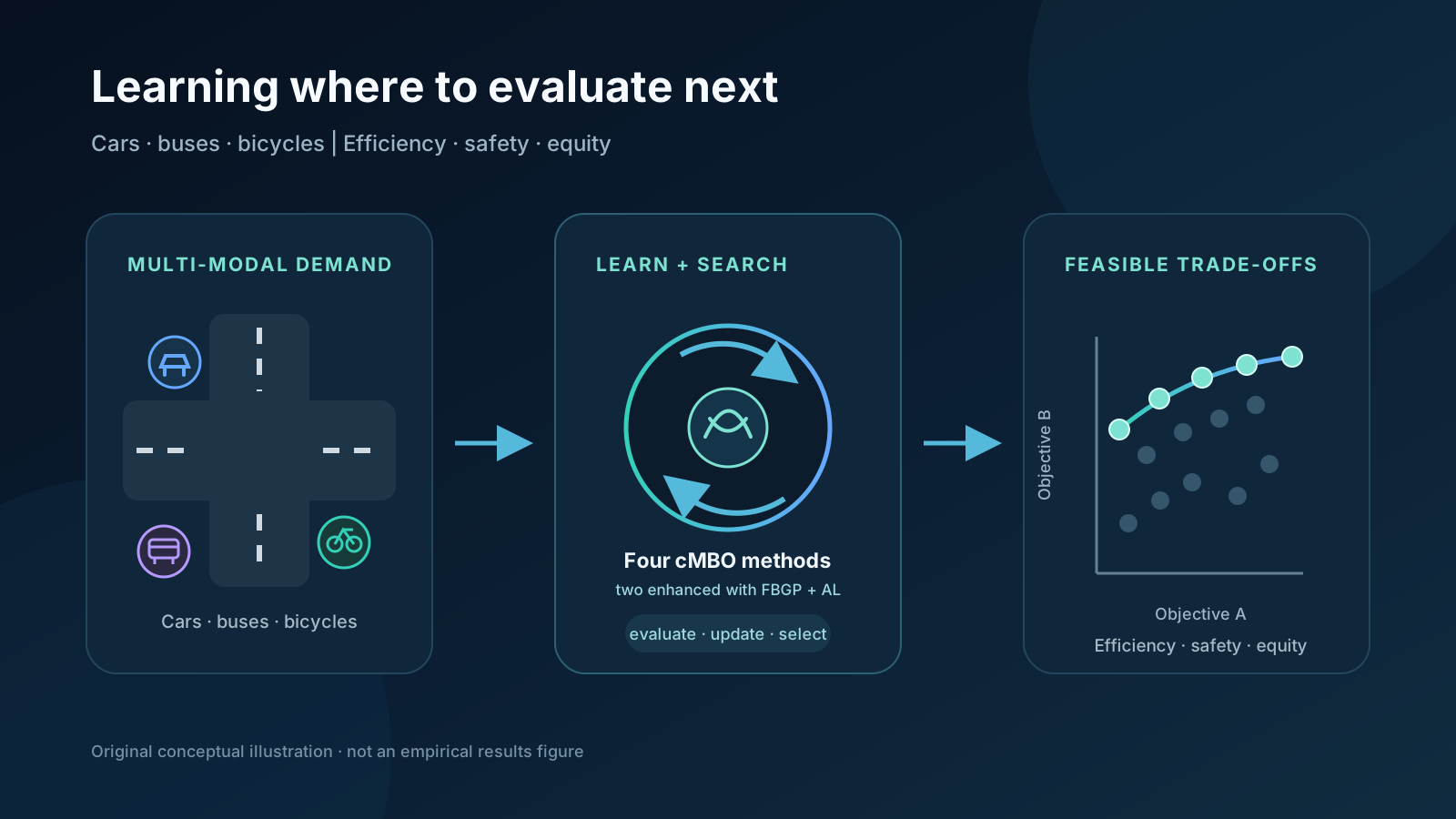
The illustration above is an original conceptual diagram for this post, not a figure reproduced from the paper and not a plot of its numerical results. Its three panels correspond directly to the study:
- private cars, buses, and bicycles at a signalised junction;
- four cMBO methods, including two enhanced with FBGP and active learning; and
- a conceptual projection of the Pareto frontier across efficiency, safety, and equity.
Publication details
- Authors: Yunhai Gong, Christoffer Riis, Shaopeng Zhong, Tao Wang, Filipe Rodrigues, Carlos Lima Azevedo, and Yu Jiang
- Journal: Transportation Research Part C: Emerging Technologies
- Volume: 192 (2026)
- Article number: 105872
- DOI: 10.1016/j.trc.2026.105872
- Article access: View the record on ScienceDirect
- Website announcement: Publication announcement and concise summary

Enjoyed this post?
Follow me on LinkedIn for more insights on public transport optimization and research updates.
Follow on LinkedIn