Andy Burnham’s public transport record, 2017–2026
A source-based review of selected public transport decisions, plans and implemented actions during Andy Burnham’s period in office.
Purpose and scope
Public transport shapes access to work, education, healthcare and social life. It also affects social inclusion, economic participation, traffic, emissions and the environmental sustainability of towns and cities.
Andy Burnham’s mayoral profile became closely associated with public transport reform, particularly bus franchising and the Bee Network. Following his appointment as Prime Minister on 20 July 2026, this review looks back at selected system-level actions during his tenure as Mayor of Greater Manchester, from May 2017 until the office became vacant on 19 June 2026. It covers strategy, governance, services, fares, ticketing, concessions, passenger-safety reporting, Metrolink, fleets, depots and plans for local rail integration. It distinguishes announcements and plans from decisions and operational measures, does not attribute collective institutional delivery to Burnham alone, and does not assess policy effects. Routine timetable changes and projects outside this public-transport and system-level scope are excluded. Sources and implementation status were checked to 23 July 2026.
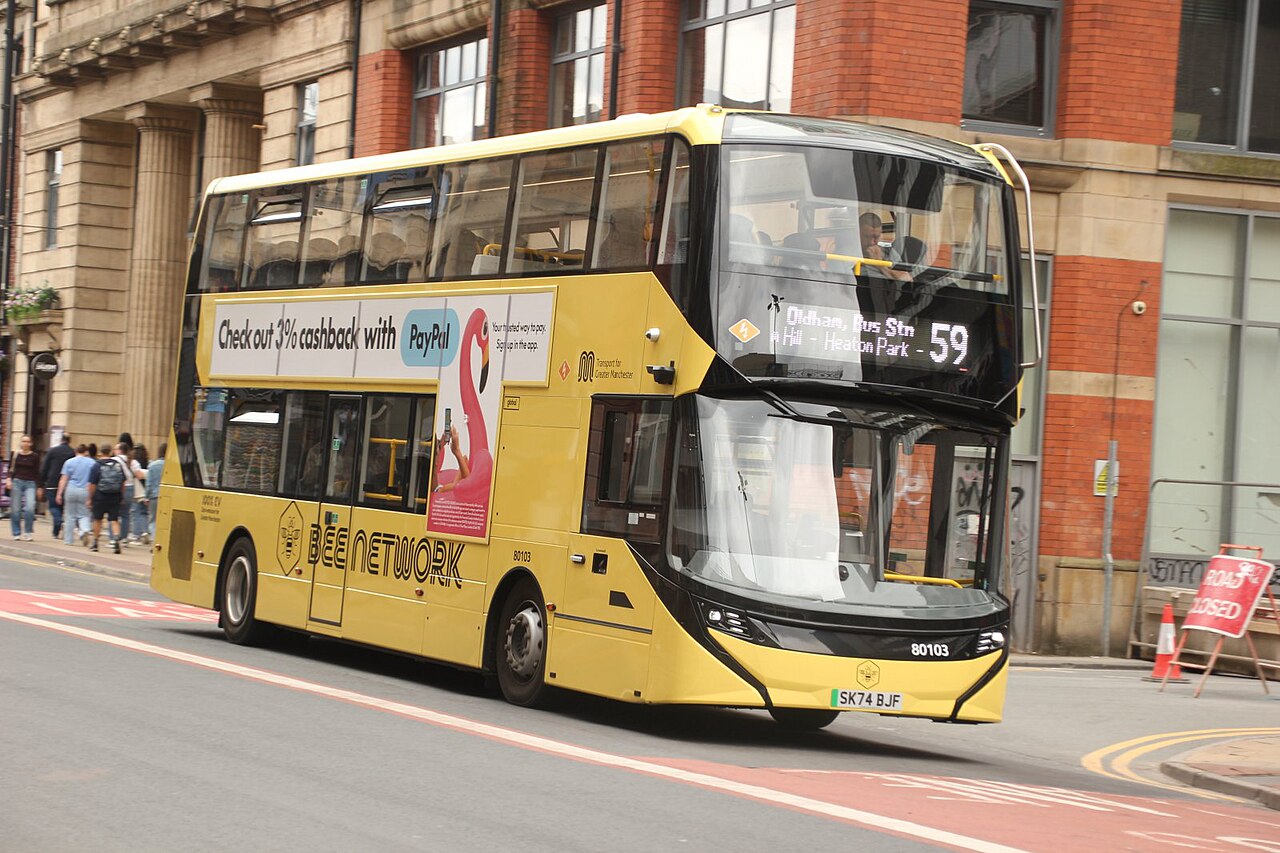
Bee Network electric bus on route 59 in Manchester’s Northern Quarter, 27 July 2025. Photograph by Matthew Black, via Wikimedia Commons, licensed under CC BY-SA 4.0. Resized for web display; no other changes.

Action timeline
Figure 1 presents selected milestones in chronological order; it is not an exhaustive list of the actions discussed below. The status labels refer to the position recorded by the cited sources on 23 July 2026: implemented; formal decision, published plan or confirmed order; and announced.
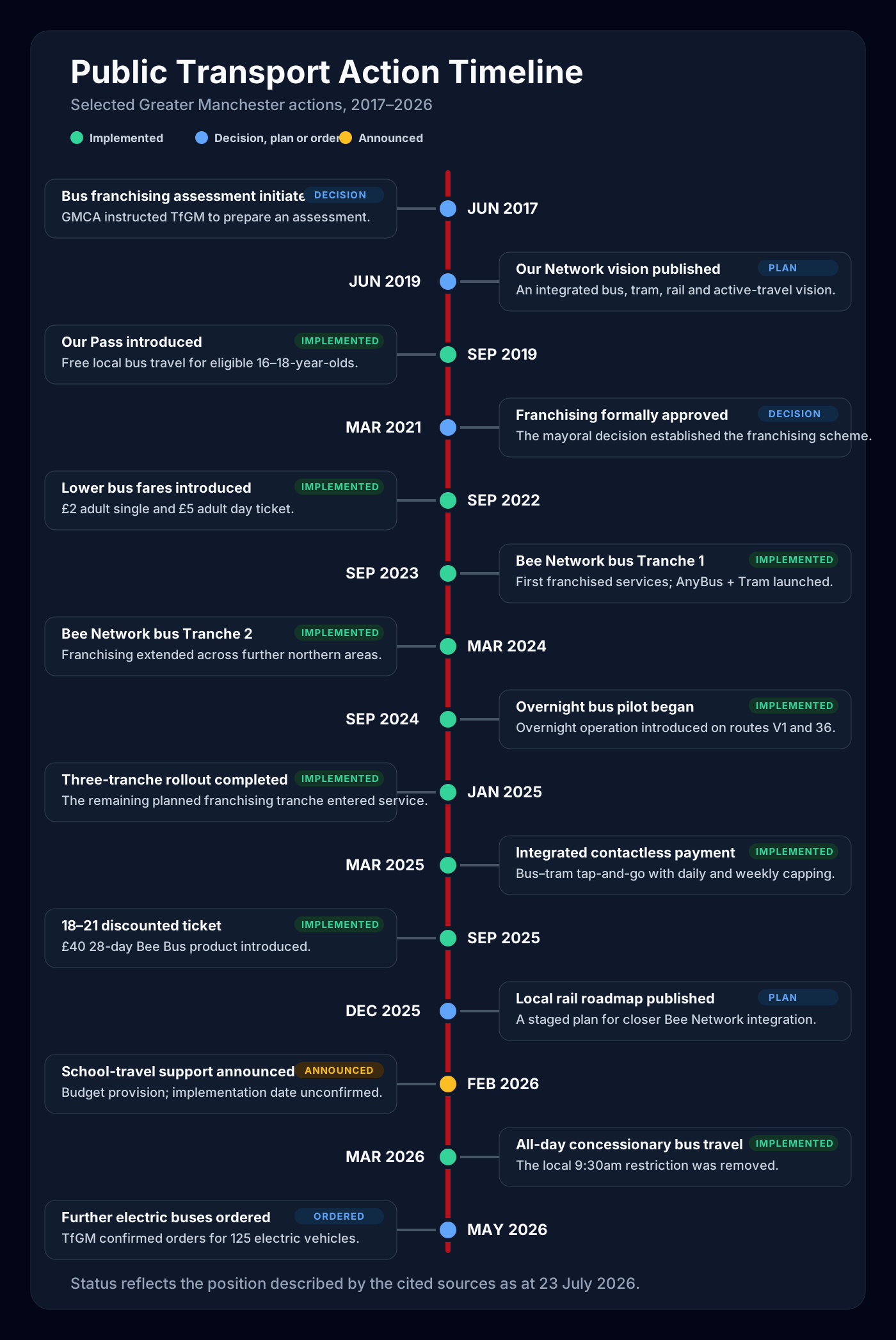
Figure 1. Selected Greater Manchester public transport actions. Green denotes implemented measures, blue a formal decision, published plan or confirmed order, and amber an announced measure.
Classification by transport planning and operations component
The chronological actions are grouped below by the part of the public transport planning and operating system to which they relate. This component-based classification is used for the remainder of the review.
| Component | Scope in this review | Dates covered in the review |
|---|---|---|
| Institutional governance and contracting | Franchising assessment, formal decision, contract-based operation and staged transfer of network control | June 2017; March 2021; September 2023; March 2024; January 2025 |
| Strategic network planning and modal integration | Statutory and supporting strategies, bus–tram integration, rapid-transit planning and planned local rail integration | June 2019; January 2021; July and September 2023; July 2024; May, November and December 2025 |
| Rapid-transit infrastructure and capacity | Metrolink line opening and additional tram capacity | March 2020; 2018–October 2022 |
| Service planning and operations | Selected changes to the scheduled operating span of bus routes | September 2024; July and September 2025 |
| Passenger safety and customer reporting | Programme decisions and a system-wide channel for reporting incidents on buses and trams | May and October 2025 |
| Fare policy, concessions, ticketing and payment | Fare levels, eligibility, multimodal products, contactless payment and fare capping | January, July and September 2019; September 2020; September 2022; January and September 2023; January, March, September and December 2025, plus a care-leaver extension completed earlier that year; February and March 2026 |
| Fleet and depot planning | Depot control, vehicle funding and procurement, fleet introduction and charging infrastructure | July and December 2022; August and September 2023; March, July and October 2024; May 2026 |
Institutional governance and contracting
This component records the allocation of network-planning responsibilities, the formal franchising decision, contract-based operation and the staged transfer of local bus services. It does not list every franchise contract or subsequent re-procurement decision.
June 2017 — franchising assessment initiated
GMCA instructed TfGM to prepare an assessment of a proposed bus-franchising scheme. This was the assessment stage rather than approval or implementation of a scheme.
March 2021 — franchising formally approved
Following the assessment and consultation, Burnham made the mayoral decision to introduce bus franchising on 25 March 2021; the scheme itself was made on 30 March. These dates are recorded in GMCA’s formal decision record and bus-reform notices.
September 2023 — Tranche 1 entered operation
The first franchised service left Farnworth bus station at 4.30 am on 24 September 2023. Tranche 1 covered Bolton and Wigan and parts of Bury, Salford and Manchester. GMCA and TfGM specified the services, while contracted operators ran them. Some GMCA summary pages list 23 September; this review uses 24 September because the detailed operational report identifies it as the start of scheduled passenger operation.
March 2024 — Tranche 2 entered operation
The second tranche began on 24 March 2024. It covered Oldham, Rochdale and parts of Bury, Salford and north Manchester, as recorded in GMCA’s franchising chronology.
January 2025 — franchising rollout completed
On 5 January 2025, the third and final planned tranche brought services in Stockport, Tameside, Trafford and parts of Manchester and Salford into the franchised system. This completed the three-tranche rollout. It did not remove the separate service-permit mechanism for the small number of services outside the franchised network.
GMCA describes its role as planning the bus network, choosing operators, deciding where, how often and when services run, and setting performance targets. TfGM describes the delivery arrangement as services being run under contract by commercial bus operators. GMCA’s description of the earlier system states that individual operators decided routes, timetables, tickets and standards, while the public sector paid to fill gaps where necessary. Figure 2 summarises this published allocation of responsibilities; it is not a statutory organisation chart or an assessment of service performance. A small number of cross-boundary services may operate outside the franchised network under TfGM service permits.
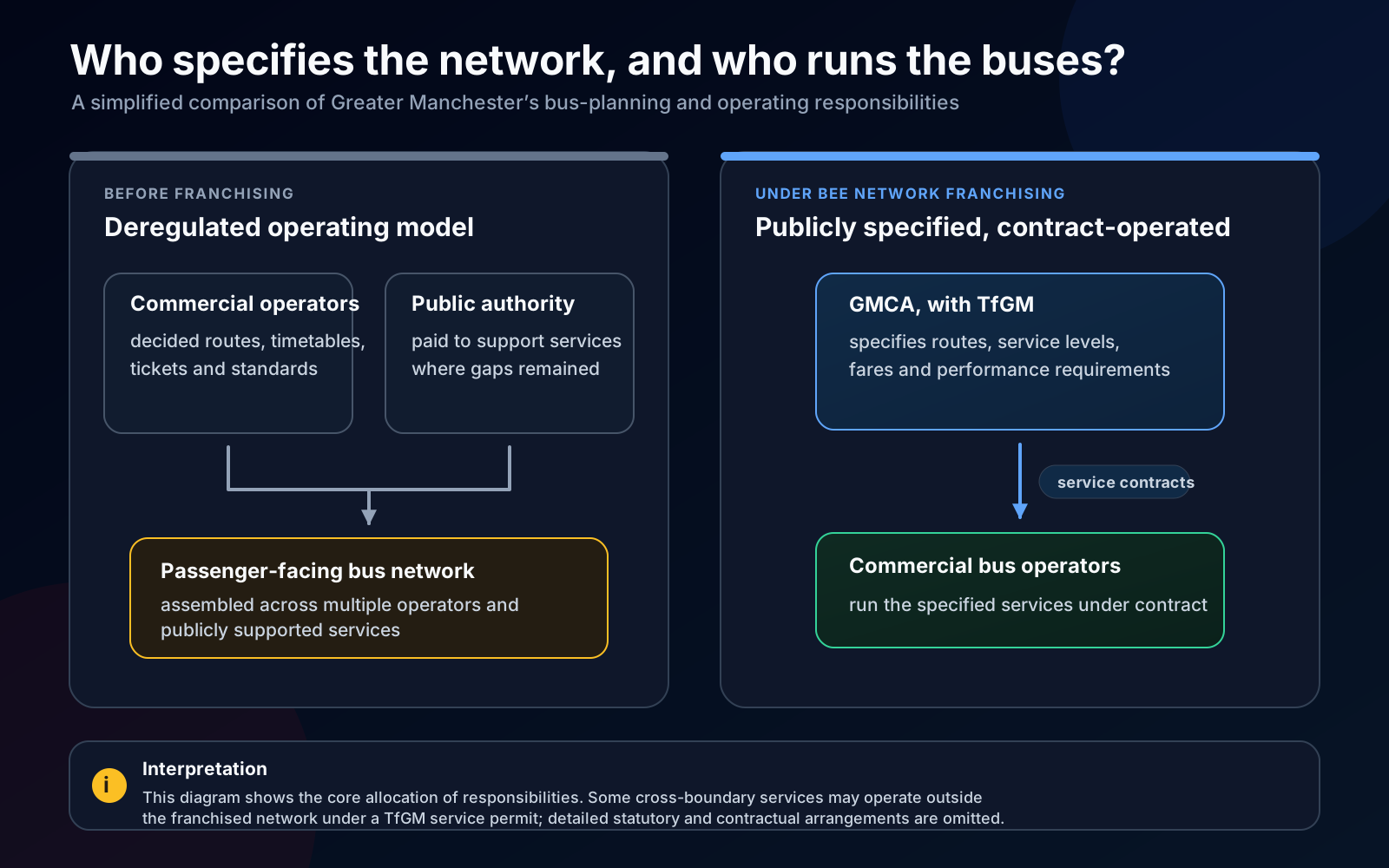
Figure 2. Simplified allocation of bus-planning and operating responsibilities before and after franchising. Based on GMCA’s descriptions of bus franchising and the earlier operating model, together with TfGM’s Bee Network description and service-permit guidance.
Strategic network planning and modal integration
This component covers statutory and supporting transport strategies and actions that connect bus services with Metrolink and local rail through fares, ticketing, branding or station arrangements. Approval of a strategy records a planning decision; it does not establish that every scheme or target in that document was funded or delivered.
June 2019 — Our Network published
GMCA published the Our Network programme in June 2019. GMCA described it as a ten-year plan to create an “integrated, modern and accessible public transport system”. The programme covered bus, Metrolink, local rail, walking and cycling.
January 2021 — Transport Strategy 2040 refresh and delivery plan adopted
On 29 January 2021, GMCA approved a refreshed Greater Manchester Transport Strategy 2040 and the Five-Year Transport Delivery Plan 2021–2026. The strategy is Greater Manchester’s statutory local transport plan; the delivery document set out projects to deliver or develop and powers to seek. The decision did not convert every project in the plan into a funded commitment.
July 2023 — Greater Manchester Bus Strategy approved
On 28 July 2023, GMCA approved the Greater Manchester Bus Strategy document presented to it as a draft. The published strategy set planning guidelines and an initial target of 30% growth in bus patronage by 2030 from a 2022/23 baseline. That target is a stated institutional objective rather than an outcome established by this review.
September 2023 — Bee AnyBus + Tram introduced
The Bee AnyBus + Tram product was introduced with Tranche 1 of bus franchising. GMCA’s post-launch account records the product as available from the launch, while the original product notice specifies unlimited travel on Greater Manchester bus services and the Metrolink zone or zones purchased.
July 2024 — draft Rapid Transit Strategy approved for engagement
On 12 July 2024, GMCA approved the draft Greater Manchester Rapid Transit Strategy for wider engagement. The document considered the future role of Metrolink, tram-train, bus rapid transit and other high-capacity corridors. Its status was a draft strategy for engagement, not approval or funding of the individual schemes shown in it.
May 2025 — School Travel Strategy adopted
On 30 May 2025, GMCA approved the final Greater Manchester School Travel Strategy, a sub-strategy of the 2040 Transport Strategy covering walking, wheeling, cycling and public transport for travel to school and further education. This review records adoption of the strategy, not delivery of all measures described in it.
November 2025 — draft Transport Strategy 2050 opened to consultation
On 28 November 2025, GMCA endorsed the draft Greater Manchester Transport Strategy 2050 and draft Delivery Plan 2027–2037 and approved public consultation. The consultation closed on 9 March 2026. TfGM continued to describe both documents as drafts at this review’s cut-off, so they are not presented here as the adopted replacement for the 2040 strategy and 2021–2026 delivery plan.
December 2025 — rail vision endorsed and integration roadmap published
In December 2025, GMCA endorsed On the Right Track for Growth: the Greater Manchester Rail Vision to 2050 and TfGM published a staged local rail-integration roadmap. The roadmap proposed changes in stages through 2030, including fare and ticketing arrangements, Bee Network branding, customer information and station upgrades. TfGM states that timings remain subject to continuing work with the Department for Transport, Network Rail, Shadow Great British Railways and train operating companies. Figure 1 therefore classifies this action as a published plan, not completed rail integration.
Rapid-transit infrastructure and capacity
This component records major changes to Metrolink infrastructure and vehicle capacity completed during the review period. It distinguishes delivery from the policy aims attributed to those projects.
March 2020 — Trafford Park Line opened
The 5.5-kilometre Trafford Park Line opened on 22 March 2020 between Cornbrook and the Trafford Centre. An official network performance report records the opening date and service endpoints; GMCA’s project announcement records the £350 million scheme and six new stops. The project should not be attributed to Burnham alone: public consultation took place in 2014, statutory powers were granted in October 2016, and construction began in January 2017, before he became Mayor. Its opening, rather than its initiation, falls within this record.
2018–October 2022 — 27 additional trams ordered and introduced
The additional-capacity programme comprised 27 trams ordered in 2018. A GMCA delivery report records a £72 million investment, funded through the government’s Transforming Cities Fund, and states that all 27 vehicles had been delivered and entered service by October 2022. The report identifies additional capacity and operational resilience as purposes of the programme; this review does not treat those purposes as an independently measured effect.
Service planning and operations
This component covers selected changes to the scheduled operating span of bus routes. It is not a route-by-route account of network planning.
September 2024 — overnight bus pilot began
Overnight journeys began on the V1 and 36 corridors in September 2024. The pre-launch notice described the intended service, and the later Night Bus Pilot and Future Options report records its introduction and operation. The programme was publicly labelled a “24-hour” pilot, but the operational change was the addition of overnight journeys on those corridors, not continuous operation of every Bee Network route.
July 2025 — pilot continued and further routes approved
On 24 July 2025, the Bee Network Committee approved continuation of the V1 and 36 services and further pilots on routes 135 and 17. The approval is recorded in the committee’s meeting record; the accompanying Night Bus Pilot and Future Options report provides the route and operating-schedule details. A later committee performance report records the 17 and 135 services as introduced in September 2025; they also appear on TfGM’s current night-bus page.
Passenger safety and customer reporting
This component records system-level changes to the organisation of transport safety and the channels available to passengers. It does not infer changes in crime, perceived safety or enforcement effectiveness from the existence of those measures.
May–October 2025 — safer-transport programme approved and TravelSafe LiveChat launched
On 29 May 2025, the Bee Network Committee supported a three-phase approach to an integrated transport-policing “11th District” and noted the first-phase programme, including a dedicated TravelSafe LiveChat facility. A later Bee Network Committee report records the dedicated service as launched in mid-October 2025. It connected passengers reporting criminal or antisocial behaviour on buses or Metrolink to police call handlers. The committee report’s usage and case examples are institutional monitoring evidence; this review does not use them to claim a causal safety effect.
Fare policy, concessions, ticketing and payment
This component covers the price of travel, eligibility for discounted or free travel, multimodal fare products, payment media and fare-capping rules.
January 2019 — Metrolink zonal fares introduced
Metrolink replaced stop-to-stop fares with a four-zone system in January 2019. TfGM’s fare-zone case study records the change and states that it would enable future integration with other modes. A contemporaneous statement by Burnham attributes to TfGM a calculation that four in five journeys were cheaper than they otherwise would have been. Both are institutional claims; neither is adopted here as an independently tested effect.
July 2019 — contactless payment introduced on Metrolink
Contactless touch-in and touch-out payment with daily capping was introduced on Metrolink in July 2019. The implementation and operating arrangement are recorded in the Metrolink Annual Performance Report. At that stage the tap-and-go arrangement applied to Metrolink; integrated bus–tram contactless payment followed in March 2025.
September 2019 — Our Pass introduced
A post-launch bus performance report records Our Pass as introduced on 1 September 2019, providing free local-bus travel for participating 16–18-year-olds resident in Greater Manchester, together with half-price off-peak Metrolink day and weekend products. It began as a pilot. On 27 January 2023, GMCA approved continuing funding, subject to an annual performance review.
September 2020 and 2025 — care-leaver bus entitlement introduced and extended
In September 2020, Greater Manchester extended free local-bus travel and Our Pass benefits to eligible care leavers aged 18–21, as recorded in the original mayoral announcement. A July 2025 Bee Network Committee report states that extension to age 25 had been completed earlier in 2025. TfGM’s current eligibility page specifies free bus travel for qualifying applicants until their 25th birthday. The two stages are separated here because the 2025 action expanded an existing scheme rather than creating it.
September 2022 — £2 single and £5 day fares introduced
On 4 September 2022, Greater Manchester introduced a £2 adult and £1 child single fare, together with £5 adult and £2.50 child day tickets, across bus operators. This occurred before the first franchised services. GMCA’s implementation notice records the launch date and prices; the enabling GMCA decision allocated Department for Transport Bus Service Improvement Plan funding, subject to agreement with government and operators. TfGM’s low-fares evaluation lists its objectives as “Help with the cost-of-living crisis”, “Increase bus patronage” and “Promote travel behaviour change”. These are TfGM’s stated objectives, not findings of this review.
January 2023 — weekly bus fare cap introduced
Following a GMCA decision in December 2022 and agreement with operators and Greater Manchester Travelcards Limited, the seven-day AnyBus product was capped at £21 for adults and £10.50 for children from 8 January 2023. A later GMCA implementation report records that the cap had gone live. The prices were subsequently reduced in January 2025, as recorded below.
September 2023 — multimodal fare product added
The Bee AnyBus + Tram action appears under modal integration above. Within the fare system, it introduced a product covering bus and the Metrolink zone or zones purchased rather than a bus-only fare.
January 2025 — Bee Bus period-ticket prices revised
From 5 January 2025, the adult seven-day Bee Bus ticket was priced at £20 and the 28-day ticket at £80, with corresponding child products at £10 and £40. The formal GMCA decision record approved those prices and a paper Hopper product, allowing transfers to other Bee Network buses within 60 minutes of purchase. A separate September 2024 GMCA decision approved an £800 adult annual Bee Bus ticket and endorsed a credit-union payment route. TfGM’s current transition guidance records the period tickets, Hopper and credit-union route as implemented. These are fare-product and payment-access changes, not evidence of an effect on demand or affordability.
March 2025 — integrated contactless payment introduced
On 23 March 2025, contactless tap-and-go was introduced across Bee Network bus and Metrolink services for full-fare adult travel. The arrangement applies daily and weekly caps when the passenger uses the same card or contactless device. Concessionary and child products remain subject to separate rules.
September 2025 — 18–21 discounted ticket introduced
In August 2025, GMCA approved a half-price 28-day Bee Bus ticket for Greater Manchester residents aged 18–21. The supporting committee report specified introduction from September at £40, half the standard £80 adult price then in force. TfGM’s current product page confirms that the product entered operation and records the age and residency conditions, the £10 administration fee and the requirement to use a Pass ID. The pass is an entitlement to buy the discounted ticket; it is not itself a travel ticket.
December 2025 — bus and tram fares frozen for 2026
A March 2026 Bee Network Committee report records that Burnham announced in December 2025 that Bee Network bus and Metrolink fares would remain frozen during 2026. This review attributes the statement to the committee report and does not infer an effect on patronage or household expenditure.
February 2026 — free school travel for children in temporary accommodation announced
At its meeting on 13 February 2026, GMCA recorded that the 2026/27 budgets contained provision for free travel passes for children in temporary accommodation. The record explicitly said that implementation dates were still to be confirmed. A March committee report attributes the announcement to Burnham. This review therefore classifies the action as announced and budgeted, not implemented.
March 2026 — all-day concessionary bus travel introduced
Greater Manchester tested removal of the weekday pre-9.30 am restriction in August and November 2025. Following those trials, Burnham’s formal decision of 15 January 2026 varied the local concessionary scheme from 1 March 2026. GMCA’s post-implementation account confirms that eligible older and disabled TfGM pass holders could then use buses within Greater Manchester throughout the day. This is a local enhancement to the national concessionary scheme; it does not extend free travel beyond the geographical and service conditions of the Greater Manchester arrangement.
Fleet and depot planning
This component covers depot control, vehicle funding and procurement, planned fleet deployment, depot electrification and charging infrastructure. Funding approval, vehicle ordering and entry into service are treated as different stages.
July 2022–September 2023 — depot-control arrangements approved
In July 2022, GMCA delegated authority to negotiate and approve the acquisition of bus depots needed to support franchising. A September 2023 decision approved procedural changes for later depot acquisitions and delegated depot management, maintenance and insurance to TfGM on GMCA’s behalf. These were enabling governance and asset-control decisions; they are not claims about depot operating performance.
July 2022 — ZEBRA funding allocated
GMCA received £35.7 million from the government’s Zero Emission Bus Regional Areas fund. The GMCA decision record combined this with £37.2 million of Stagecoach match funding and a £12.5 million GMCA contribution for 170 zero-emission buses and associated electrification work. The same decision delegated procurement of an initial 50 zero-emission buses for the first franchising tranche using City Region Sustainable Transport Settlement funding. This paragraph records funding and procurement decisions, not completion of either deployment timetable.
December 2022 — second 50-bus electric order confirmed
After the first 50-bus procurement, a further order for 50 electric double-deck buses was announced in December 2022 for the second franchising tranche. The £22.7 million order was funded from Greater Manchester’s City Region Sustainable Transport Settlement.
August 2023 — first fleet of 50 zero-emission buses unveiled
TfGM unveiled a first fleet of 50 new zero-emission Bee Network buses in August 2023 and stated that the vehicles would be rolled out when the first franchised services began the following month.
March 2024 — Oldham depot electrification completed
Electrification work at Oldham bus depot was completed in March 2024. The reported work included charging infrastructure for the electric fleet based at the depot.
July 2024 — 100 CRSTS-funded zero-emission buses recorded in operation
A September 2024 committee report records the operational position as at July 2024: 100 CRSTS-funded Bee Network zero-emission buses, split equally between Bolton and Oldham depots. This is evidence of entry into operation for those two fleets; it should not be read as completion of the separate 170-bus ZEBRA programme.
October 2024 — further fleet transactions approved
GMCA approved borrowing of up to £71.2 million for three fleet transactions: purchase of 72 Euro VI diesel buses, purchase or novation of up to 94 zero-emission buses, and short-term grant funding for ZEBRA vehicles previously procured by Stagecoach. This was a financing and asset decision. The reference to diesel vehicles is retained because a complete fleet record should not imply that every fleet intervention was zero-emission.
May 2026 — further 125 electric buses ordered
TfGM confirmed orders for a further 125 electric buses. Figure 1 records the confirmed order separately from entry into passenger service; the source did not establish that all 125 vehicles had entered service by the cut-off date.
Method and source limitations
All links in the article were checked on 23 July 2026. The sources are used as follows:
Primary institutional records are used according to the claim being made: decision and committee records for formal approval; reports for the content of proposals and evaluations; implementation records or current product pages for measures in operation; and launch notices for announced scope. A proposal or pre-launch notice is not treated as evidence of later implementation unless a subsequent source reports implementation.
- GMCA decision records and programme pages are cited for the franchising chronology, formal responsibilities, funding decisions and stated regional plans.
- TfGM pages are cited for specified launch dates, current ticket conditions, procurement announcements and reported delivery milestones.
- Committee papers are cited for decisions taken through the Bee Network Committee and the mayoral decision process.
- TfGM and GMCA evaluation reports are identified as internal evaluations produced by organisations involved in the programme; no causal findings from those reports are adopted as conclusions in this review.
Most evidence used here is administrative or institutional rather than independent. It is suitable for establishing what was decided, funded, announced or reported as delivered, but it cannot by itself establish causal effects, value for money or the experience of all passengers. The selection is designed to cover major system-level actions within the stated scope and mayoral period; it should not be read as a complete register of every Greater Manchester transport decision.
This post is part of the OptiTransit Commentary series on public transport policy and operations.
Acknowledgement
This blog was co-created with Codex 5.6 Sol.

Enjoyed this post?
Follow me on LinkedIn for more insights on public transport optimization and research updates.
Follow on LinkedIn